
Heard of Passive Optical LAN?
28th September 2026

Here’s Why Enterprise Networks Are Taking a Closer Look
There is a good chance that your organisation has invested heavily in its network infrastructure over the years.
There may be structured copper cabling running throughout your buildings, fibre connecting communications rooms, access switches distributed across floors and wireless access points providing connectivity to users and devices. It is a familiar architecture, proven across thousands of organisations and capable of supporting an enormous range of applications.
So why are organisations increasingly looking at a different approach?
Passive Optical LAN, commonly abbreviated to PON or POL, is attracting growing attention within enterprise networking because it takes a fundamentally different approach to how connectivity is distributed through buildings and campuses. Rather than relying predominantly on a hierarchy of active switching equipment and copper cabling, PON uses Passive Optical Network technology to take fibre much deeper into the network.
It is not a new concept, however. Passive Optical Network technology has been used extensively in telecommunications for many years, while Optical LAN has subsequently developed as an enterprise application of that architecture. What is changing now is the level of attention the technology is receiving within the wider ICT industry.
In June 2026, BICSI established its Optical LAN Council, bringing optical LAN knowledge, education and technical engagement into a broader standards-aligned ICT framework. The move is significant because it places Optical LAN within the wider professional conversation around how modern infrastructure should be designed, evaluated and implemented.
For organisations considering their next network refresh, refurbishment or new-build project, that makes Passive Optical LAN a technology worth understanding.
What is Passive Optical LAN?
Passive Optical LAN applies Passive Optical Network technology to an enterprise local area network.
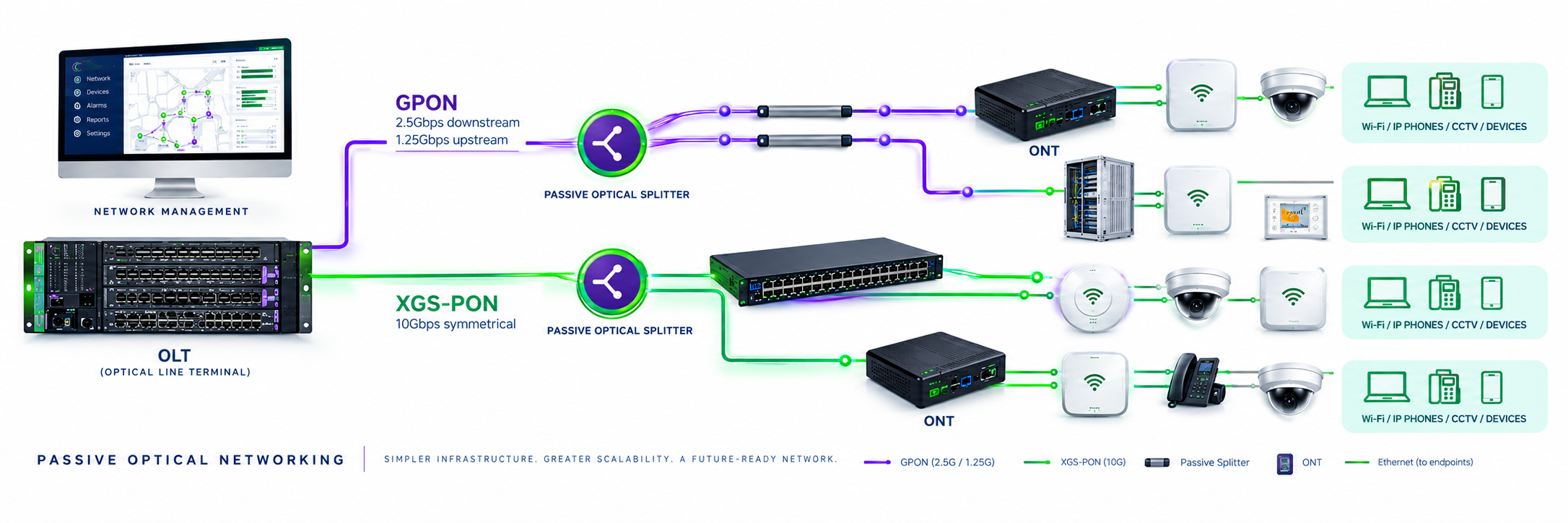
At the centre of the architecture is an Optical Line Terminal, or OLT. From there, the optical signal is distributed through single-mode fibre and passive optical splitters before reaching Optical Network Terminals, or ONTs, positioned closer to the users and devices they serve.
The ONT provides the Ethernet connectivity required by endpoints such as computers, phones, wireless access points, security systems and other connected devices. The important distinction is architectural, where instead of placing active switches throughout a building and using those switches to distribute connectivity towards the edge, POL allows the passive optical network to extend much further into the building or campus.
That creates a simpler physical network architecture in which more of the intelligence and management can remain centralised while fibre carries connectivity much deeper into the environment.
Why is fibre becoming more important inside the enterprise?
For years, fibre has largely been associated with the backbone of an enterprise network. It connected buildings, linked communications rooms and provided high-capacity uplinks between critical network components and now that role is changing.
Modern organisations are connecting more devices, using more cloud applications and placing greater reliance on wireless connectivity. Wi-Fi has become fundamental to how employees, customers, students, visitors and operational teams interact with technology, while IoT, security, building management and other connected systems continue to increase the number of endpoints a network needs to support. The result is a network environment in which the edge is more business critical than ever, and Passive Optical LAN takes fibre closer to that edge.
For organisations designing a new network, this creates an opportunity to consider whether the traditional model of multiple communications rooms, large quantities of copper cabling and extensive access switching is still the most appropriate architecture for the building.
How does Passive Optical LAN work?
A typical PON or POL architecture consists of an OLT, passive optical splitters, single-mode fibre and ONTs.
The OLT provides central aggregation and network intelligence. The passive splitter distributes the optical signal without requiring active electronics at the splitting point. Fibre then carries connectivity towards ONTs, which provide the Ethernet interfaces required by connected devices. The exact design depends on the environment, endpoint density, required services, distances, optical budget, power strategy and network architecture.
Modern PON technologies also provide a path towards higher-capacity connectivity. GPON provides multi-gigabit downstream capacity, while XGS-PON supports symmetrical 10Gbps connectivity. Current enterprise platforms can support migration between generations, allowing organisations to increase capacity as requirements develop rather than treating the underlying fibre infrastructure as something that must repeatedly be replaced. Hold that thought…
The objective is to build an infrastructure capable of adapting when those requirements become clear.
What are the potential benefits?
One of the most obvious benefits of Passive Optical LAN is the reduction in active network equipment required throughout the building.
A traditional switched architecture can require multiple layers of switching and extensive communications-room infrastructure. POL can reduce the number of active elements required between the network core and the connected endpoint. That can have implications for space, power, cooling, cabling and ongoing maintenance.
The physical footprint of the network can become smaller, while fibre provides a high-capacity medium capable of supporting future generations of network technology. There is also a potential operational benefit. Centralised management can make network provisioning, moves, additions and changes more consistent, while software-defined approaches allow network policies and resources to be managed centrally. The result is an architecture designed around simplification rather than continually adding layers of infrastructure as requirements increase.
Is Passive Optical LAN suitable for every organisation?
No, and that is an important part of any serious discussion about PON.
Network architecture should be determined by the requirements of the organisation and the environment in which the network will operate.
Passive Optical LAN can be particularly interesting for large offices, campuses, education environments, healthcare facilities, hospitality, logistics operations, public sector estates and other environments where there are substantial numbers of endpoints, significant floor areas or multiple buildings to connect. Existing infrastructure is also a real consideration.
Some organisations may benefit from a new fibre-deep architecture, while others may have existing copper, multimode fibre or switching infrastructure that should be retained as part of a phased migration.
The right answer therefore starts with assessment rather than technology selection.
What does this mean for Wi-Fi?
This is one of the most interesting applications of PON.
Wireless access points are becoming increasingly capable, and the network underneath them needs to provide the bandwidth and connectivity required to support that capability.
Passive Optical LAN can take fibre closer to wireless infrastructure while providing Ethernet and PoE connectivity at the edge through suitable ONTs.
For organisations planning high-density Wi-Fi environments, this creates an opportunity to consider the wireless network and its underlying physical infrastructure as one connected design problem rather than treating them as separate projects. The same principle applies to security cameras, access control, building automation, IoT devices and other connected systems. The network is becoming the foundation on which the building operates.
Why is C-Tech Solutions investing in Passive Optical LAN?
At C-Tech Solutions, our work has always centred on the physical and technical infrastructure that allows organisations to connect, operate and grow.
We have delivered structured cabling, fibre optic, Wi-Fi and network infrastructure projects across commercial, public sector, retail, logistics, education and other demanding environments throughout the UK and Europe.
Passive Optical LAN represents a natural extension of that expertise.
Our role is to understand where the architecture makes sense, assess the requirements of the organisation and provide the engineering capability required to design, install, test and commission the resulting infrastructure.
Our engineers are ready to support PON installations today.
For organisations planning a new-build project, major refurbishment, network refresh or campus-wide infrastructure programme, now is a good time to ask a simple question:
Could Passive Optical LAN provide a better foundation for your next network?
If the answer is worth exploring, C-Tech Solutions is ready to have the conversation.
Related Posts





To share this post please choose your platform!
What we offer as core solutions
for business in the North East



Accreditations & Certifications